
1 Introduction
1.1 The Xillinux distribution
Xillinux is a complete, graphical, Lubuntu 16.04-based Linux distribution for the Zynq-7000 device, intended as a platform for rapid development of mixed software / logic projects. The currently supported boards are Z-Turn Lite, Zedboard, MicroZed and Zybo.
Like any Linux distribution, Xillinux is a collection of software which supports roughly the same capabilities as a personal desktop computer running Linux. Unlike common Linux distributions, Xillinux also includes some of the hardware logic, in particular the VGA adapter.
With Z-Turn Lite, Zedboard and Zybo, the distribution is organized for a classic keyboard, mouse and monitor setting. It also allows command-line control from the USB UART port, but this feature is made available mostly for solving problems.
When used with MicroZed, which lacks a VGA/DVI output, only the USB UART is used as a console.
Xillinux is also a kickstart development platform for integration between the device’s FPGA logic fabric and plain user space applications running on the ARM processor. With its included Xillybus IP core and driver, no more than basic skills in programming and logic design are needed to complete the design of an application where FPGA logic and Linux-based software work together.
The bundled Xillybus IP cores eliminate the need to deal with the low-level internals of kernel programming as well as the interface between application logic and the processor, by presenting a simple and yet efficient working environment to the application designers.
1.2 The Xillybus IP core
Xillybus is a DMA-based end-to-end solution for data transport between an FPGA and a host that runs Linux or Microsoft Windows. It offers a simple and intuitive interface to the designer of the FPGA logic as well as the programmer of the software. It’s available for personal computers and embedded systems using the PCI Express bus as the underlying transport, as well as ARM-based processors, interfacing with the AMBA bus (AXI3/AXI4).
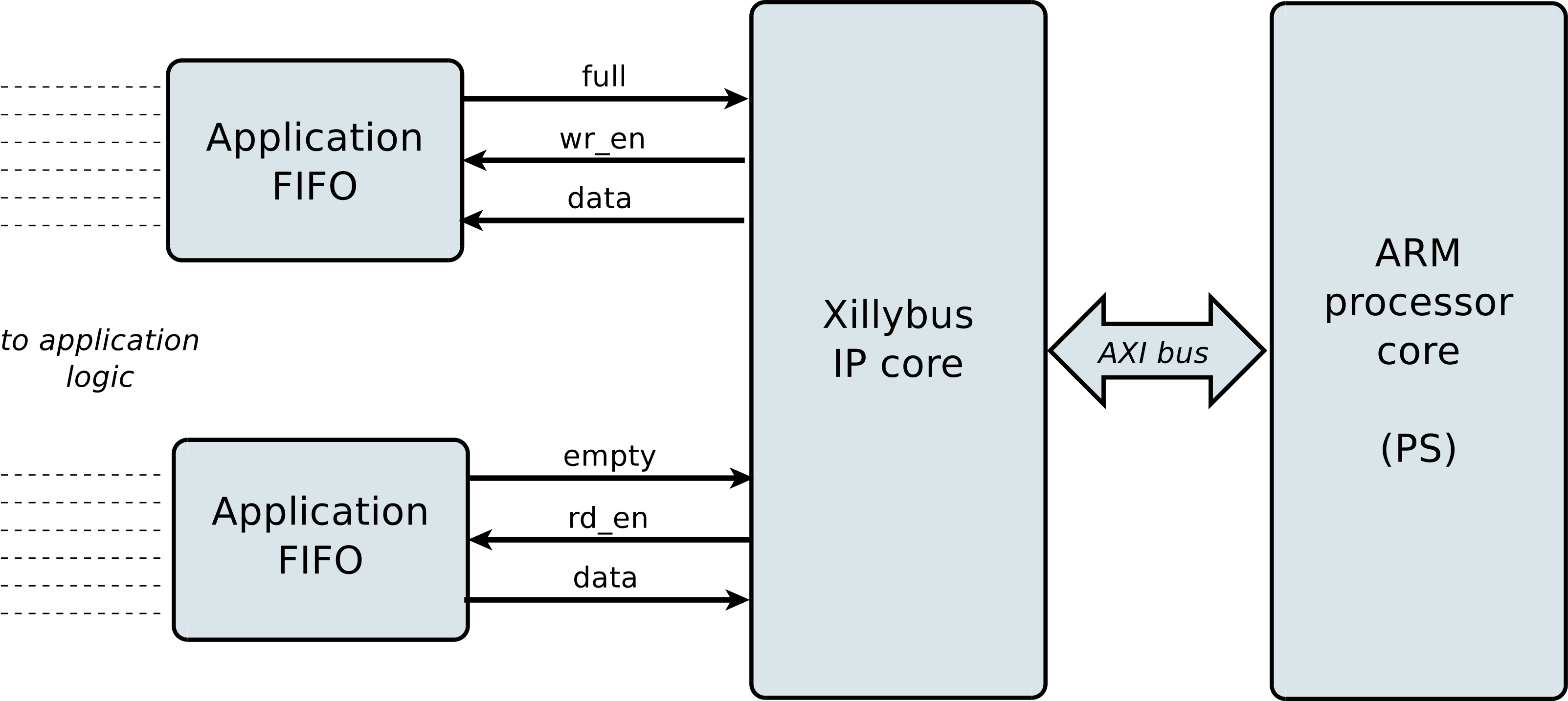
As shown above, the application logic on the FPGA only needs to interact with standard FIFOs.
For example, writing data to the lower FIFO in the diagram makes the Xillybus IP core sense that data is available for transmission in the FIFO’s other end. Soon, the IP core reads the data from the FIFO and sends it to the host, making it readable by the user space software. The data transport mechanism is transparent to the application logic in the FPGA, which merely interacts with the FIFO.
On its other side, the Xillybus IP core implements the data flow utilizing the AXI bus, generating DMA requests on the processor core’s bus.
The application on the host interacts with device files that behave like named pipes. The Xillybus IP core and driver transport data efficiently and intuitively between the FIFOs in the FPGA and their related device files on the host.
The IP core is built instantly per customer’s spec, using an online web application. The number of streams, their direction and other attributes are defined by the customer to achieve an optimal balance between bandwidth performance, synchronization, and simplicity of design.
After going through the preparation as described in this guide, it’s recommended to build and download your custom IP core at https://xillybus.com/custom-ip-factory.
This guide explains how to rapidly set up the Xillinux distribution, with a Xillybus IP core included. This IP core can be attached to user-supplied data sources and data consumers, for real application scenario testing. It’s not a demonstration kit, but a fully functional starter design, which can perform useful tasks as is.
Replacing the existing IP core with one that is tailored for special applications is a quick process, and requires the replacement of one binary file and the instantiation of one single module.
More information about using the Xillybus IP core can be found in these documents:
For those who are curious, a brief explanation on how the Xillybus IP core is implemented can be found in Appendix A of Xillybus host application programming guide for Linux.